
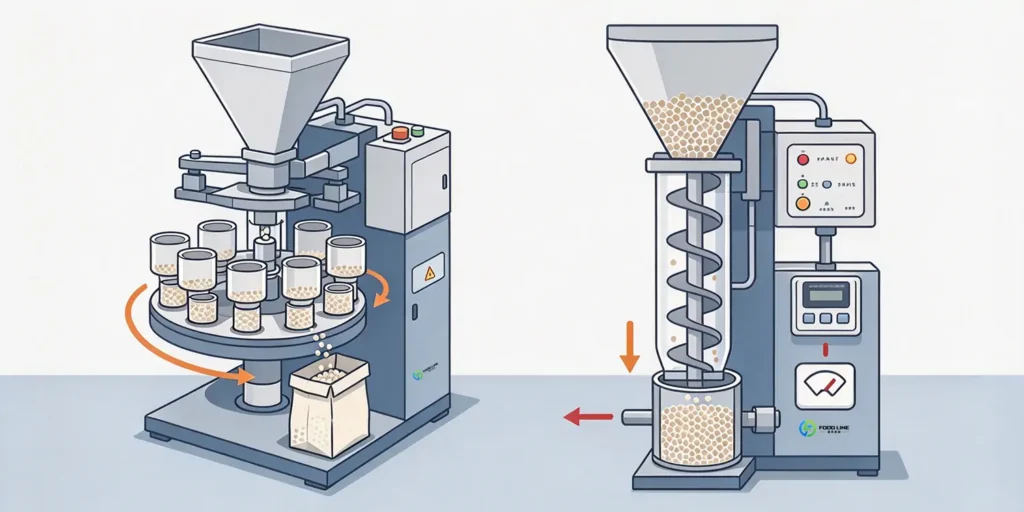
When you choose a powder packaging machine, you will note that there are 2 types of fillers: auger filler and volumetric cup filler. Which one is better for your packing materials?
For powder packaging, it depends on the physical properties of your powder and your accuracy requirements.
- Choose an auger filler for fine powders, cohesive powders, or when high precision is required;
- Choose a volumetric cup filler for free-flowing granules with stable bulk density and when high speed and low cost are pursued.
Volumetric Cup Filler
- Working Principle: Uses a fixed-volume cup to hold material; scrapes off excess after filling and then dumps it into the container. Fill weight is directly determined by cup volume and material bulk density.
- Material Compatibility: Only suitable for free-flowing, uniform granules with stable bulk density, such as sugar, salt, rice, and seeds.
- Accuracy: Relatively poor, typically ±1% to ±3% (and only when density is stable). Once powder bulk density fluctuates (such as with protein powder or flour), errors will directly increase and cannot be corrected.
- Speed: Very fast, especially rotary models, can reach 120 cups/minute or more.
- Cost: Lower, with simpler structure and lower maintenance costs.
Auger Filler
- Working Principle: A servo motor drives a screw (auger) to rotate, pushing out material. Fill amount is controlled by the number of screw revolutions, and can compensate for bulk density changes.
- Material Compatibility: Fine powders, cohesive powders, easy-to-fluidize powders (such as protein powder, flour, milk powder, pharmaceuticals), as well as various granules.
- Accuracy: High, with servo control typically achieving ±0.5% to ±1%, and it is the preferred solution for handling density variations.
- Speed: Moderate, typically 5 to 120 fills/minute (depending on system).
- Cost: Higher, because it requires servo motors, PLC control, and dedicated augers for specific products (longer changeover time)